
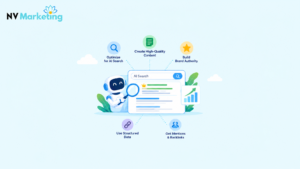
Ask ChatGPT, Perplexity, or Google’s AI Overviews to recommend a payroll tool for a 20-person company, and you’ll usually get three to five names. Every other brand in the category is invisible in that moment, no matter how good its product is.
This guide breaks down what strategies improve brand visibility in AI search engines, based on how these systems actually pick their sources. You’ll learn how AI tools decide which brands to mention, which content and off-site tactics make a real difference, what technical settings can quietly block you, and how to track progress without paying for a monitoring platform.
Much of this builds on good SEO. A few parts work differently, though, and those gaps are where most brands lose ground to competitors.
How AI Search Engines Decide Which Brands to Mention?
AI search tools draw on two sources of information. The first is what the underlying model learned during training. The second is what it retrieves from the web in real time when someone asks a question.
Tools like Perplexity, ChatGPT search, and Google AI Overviews lean heavily on that second step. They run a search, read a small set of pages, and write a summary with links. So if you want to understand how to improve brand visibility in AI search engines, start with a simple rule: you have to be findable by the search step and quotable in the summary step.
Mentions and citations are not the same thing
A mention means your brand name appears in the answer. A citation means one of your pages is linked as a source.
The two often come apart. A software review site might earn the citation for “best CRM for real estate agents,” while your brand earns the mention because that review site ranked you first. Both count, and a good strategy works on both.
Why consensus carries so much weight?
AI systems try to give safe, well-supported answers. They favor brands that many independent sources describe in a consistent way.
Picture ten articles listing the best accounting software for freelancers. If your product appears in two of them, an AI tool summarizing those pages is unlikely to name you. If it appears in eight, with similar descriptions of what you’re good at, your odds rise sharply. This is why off-site reputation matters as much as your own website.
Content Strategies That Get Your Pages Cited
Your own content is the part you control most directly, so it’s the natural starting point when working out what strategies improve brand visibility in AI search engines. The goal is pages that are easy to extract, clearly accurate, and worth citing over a competitor’s.
Put the answer first
AI tools pull short passages, not whole pages. A page that buries its answer under three paragraphs of background gives them nothing clean to lift.
Under each question-style heading, answer in the first 40 to 60 words, then expand. A physiotherapy clinic writing about frozen shoulder recovery might open with: “Most people recover in one to three years, moving through freezing, frozen, and thawing phases.” The detail, exercises, and warning signs follow below. That opening sentence is exactly the kind of passage an AI summary quotes.
This is one of the most reliable best practices for improving visibility in AI search results, and it helps with featured snippets too. [Internal link opportunity: “how to optimize content for featured snippets”]
Publish information only you have
Generic advice is everywhere, so AI tools have no particular reason to cite yours. Specific, first-hand data is different.
A freight forwarder could publish average customs clearance times from its own shipments by port. A dental practice could share what percentage of its patients needed follow-up treatment after a certain procedure. A B2B software company could release pricing benchmarks from anonymized customer data. Numbers like these get quoted because nobody else has them.
Build honest comparison and “best for” pages
Many AI queries are comparisons: “X vs Y,” “alternatives to X,” “best X for small teams.” If you don’t have pages that address these directly, the AI will rely on someone else’s version.
Write them fairly. Say where a competitor is the better choice, and be specific about who your product suits. A page claiming you win on every point reads as marketing, and summaries tend to pass over it in favor of balanced sources.
Keep key pages current
Outdated prices, old screenshots, and stats from years ago make a page less trustworthy to readers and to retrieval systems. Review your most important pages on a schedule, update the facts, and show a visible “last updated” date that reflects real changes.
Off-Site Authority: Getting Other Sources to Talk About You
Most brands spend nearly all their effort on their own website. Yet the consensus effect described earlier means some of the most effective strategies to improve brand visibility in AI search engines happen on other people’s sites.
Describe your brand the same way everywhere
AI systems build an understanding of your brand as an entity: what it is, what category it belongs to, and what it’s known for. Mixed signals weaken that picture.
A common example is a SaaS company that calls itself “workflow automation” on its homepage, “project management software” on G2, and “a productivity platform” on LinkedIn. An AI tool asked for the best project management software may not connect those dots. Pick one clear category and a one-sentence description, then use it on your website, social profiles, Google Business Profile, Crunchbase, industry directories, and author bios.
Earn a place in lists and roundups
Listicles like “best CRM tools for startups” are some of the most frequently retrieved pages for recommendation queries. Being included in the well-ranked ones is often worth more than another blog post on your own site.
Find the roundups that already rank for your category, check whether you’re listed, and reach out to the authors with accurate, useful information. Offer a free trial, a demo, or data they can reference. Digital PR, expert quotes in industry publications, and podcast appearances all feed the same pool of sources. [Internal link opportunity: “digital PR services” or “link building strategy guide”]
Get detailed reviews on the platforms AI tools read
Review sites such as G2, Capterra, Trustpilot, and Google reviews show up often in AI answers about software and local services. The detail in those reviews matters more than the star rating alone.
When you ask customers for reviews, suggest they mention their use case: “we use it to manage payroll for 40 staff across two locations.” Reviews like that help an AI tool match you to specific queries.
Take part in real community discussions
Reddit threads, Quora answers, and niche forums are regularly cited in AI answers. People trust them because they read as unfiltered opinion.
The right approach is genuine participation. Have team members answer questions in their area of expertise under their own names, disclose their affiliation, and only mention your product when it truly fits. Posting promotional replies usually gets removed and damages trust.
These recommendations to enhance brand visibility take longer than on-page changes, but they compound over time.
Technical Foundations for AI Crawlers
Great content won’t help if AI systems can’t reach or read it. The technical side of what strategies improve brand visibility in AI search engines is usually quick to check and easy to overlook.
Let the right bots in
AI companies use different crawlers for different purposes. OpenAI, for example, separates the bot that powers ChatGPT search results (OAI-SearchBot) from the one that collects training data (GPTBot). Perplexity uses PerplexityBot. Google’s AI Overviews are generally tied to regular Googlebot crawling rather than the separate Google-Extended setting.
Open your robots.txt file and confirm you aren’t blocking search-related AI crawlers by accident. Also check your CDN or security settings, since some bot-protection features can block AI crawlers by default. Your server logs will show which bots are actually reaching your pages.
Make sure key content loads without JavaScript
Many AI crawlers don’t execute JavaScript the way a browser does. If your pricing table, product descriptions, or FAQs only appear after scripts run, those crawlers may see a nearly empty page.
A quick test: view the raw page source, or load the page with JavaScript turned off. If your main content isn’t visible, talk to your developers about server-side rendering or pre-rendering for important pages.
Add structured data where it genuinely fits
Schema markup helps machines understand what a page is about. Useful types include Organization (with sameAs links to your official profiles), Product, Article with author and date details, LocalBusiness, and FAQPage.
Treat schema as a clarity tool, not a shortcut. It won’t earn citations for thin content, but it removes ambiguity about who you are and what you offer. [Internal link opportunity: “schema markup guide for beginners”]
Don’t ignore Bing
Some AI assistants, including Microsoft Copilot, rely on Bing’s index. Plenty of sites that rank well in Google are poorly indexed in Bing because nobody ever checked.
Set up Bing Webmaster Tools, submit your sitemap, and consider IndexNow so new and updated pages are discovered faster. It’s one of the simplest best practices for improving visibility in AI search results, and many competitors skip it. [Internal link opportunity: “technical SEO audit checklist”]
How to Measure Progress and Avoid Common Mistakes?
You can’t manage what you don’t track, and AI visibility doesn’t show up neatly in a rank tracker. A simple manual process works well for most brands, at least at the start.
Build a prompt list and test it monthly
Write 20 to 30 prompts your customers would realistically type. Cover different stages of the buying journey:
Discovery: “best inventory software for small retail shops”
Comparison: “Brand A vs Brand B for inventory tracking”
Validation: “is Brand A worth it for a single store”
Run each prompt in ChatGPT, Perplexity, Gemini, and Google once a month. Record whether your brand is mentioned, whether your site is cited, how accurately you’re described, and which competitors appear. Answers vary between sessions, so run important prompts more than once before drawing conclusions.
Over a few months, this log shows which strategies for AI search improvement are actually moving the needle and which prompts still exclude you.
Watch referral traffic from AI tools
In Google Analytics 4, look for sessions from sources such as chatgpt.com, perplexity.ai, gemini.google.com, and copilot.microsoft.com. Grouping them into a custom channel makes trends easier to spot. Note that clicks from Google’s AI Overviews are typically counted within regular organic search traffic [VERIFY].
Mistakes that hold brands back
Turning every page into FAQ filler. Short, direct answers help, but a page made of 40 shallow questions helps nobody.
Trusting tools that promise guaranteed AI rankings. No one controls how these systems choose sources.
Blocking crawlers without realizing it. A single robots.txt line or firewall rule can remove you from AI results.
Ignoring inaccurate answers. If AI tools describe your pricing or features wrongly, trace the claim to its likely source and correct it there, whether that’s an old page of yours or an outdated directory listing.
Measurement is also where the question of what strategies improve brand visibility in AI search engines becomes specific to your business. The tactics that work for a local law firm won’t match those for a global software brand, and your prompt log will show the difference.
Conclusion
At NV Marketing, we help businesses strengthen their online presence through practical, data-driven digital marketing strategies. As AI-powered search continues to change how people discover brands, having a strong presence across both traditional and AI search platforms is becoming increasingly important.
AI search engines reward brands that are easy to find, easy to quote, and consistently described by sources other than themselves. That means working on three fronts at once: pages that answer questions directly and share information only you have, an off-site presence built on reviews, roundups, and genuine community participation, and technical settings that let AI crawlers reach your content.
There’s no fixed formula for what strategies improve brand visibility in AI search engines, because each tool and each industry behaves a little differently. The practical recommendations to enhance brand visibility in this guide give you a solid base to test from.
A good next step is to spend an hour this week on two tasks. First, check your robots.txt and CDN settings for blocked AI crawlers. Then write your first 20 prompts and record where your brand appears today. That baseline turns how to improve brand visibility in AI search engines from guesswork into something you can measure month by month.
Frequently Asked Questions
What strategies improve brand visibility in AI search engines?
The most effective approach combines four areas: answer-first content with original data, consistent brand descriptions across the web, third-party mentions in reviews and roundups, and technical access for AI crawlers. No single tactic works alone. AI tools favor brands that are easy to find, easy to quote, and described consistently by many independent sources.
How is optimizing for AI search different from traditional SEO?
Traditional SEO focuses on ranking a page in a list of links. AI search optimization focuses on being mentioned or cited inside a written answer. The foundations overlap, including crawlability, quality content, and authority. The difference is that off-site mentions, clear entity information, and extractable answers carry more weight when an AI is summarizing several sources at once.
How long does it take to improve brand visibility in AI search engines?
Technical fixes, such as unblocking a crawler, can show results within weeks once pages are recrawled. Content updates usually take longer. Off-site work, like earning roundup placements and reviews, often takes several months to affect AI answers. Tracking a fixed set of prompts monthly is the clearest way to see how long it takes in your market.
Does schema markup help with AI search visibility?
Schema helps machines understand your brand, products, authors, and content structure. It reduces ambiguity, which supports accurate descriptions in AI answers. It does not guarantee citations on its own. Think of it as one of several supporting strategies for AI search improvement, most useful when paired with strong content and a consistent presence on trusted third-party sites.
Can small businesses compete with big brands in AI search results?
Yes, especially for specific or local queries. AI tools answering “best bakery for custom cakes in Pune” rely on local reviews, directory listings, and detailed service pages rather than brand size. Small businesses that describe their services clearly and collect detailed reviews often appear in answers where large national brands don’t.
What should I do if an AI tool gives wrong information about my brand?
Find where the incorrect claim likely comes from. Check your own older pages, business directories, review profiles, and third-party articles. Correct or update the source, publish clear and current information on your site, and retest the prompt after a few weeks. Most AI tools also offer a feedback option on individual answers.
Should I block AI crawlers from my website?
It depends on your goals. Blocking training crawlers keeps your content out of future model training, while blocking search crawlers can remove you from AI answers entirely. Many brands allow search-related bots and decide separately about training bots. Review each crawler’s stated purpose before choosing, since this is one of the strategies to improve brand visibility in AI search engines that is easy to undo by accident.